
Oriented Growth › Variable Geometries › Volume II
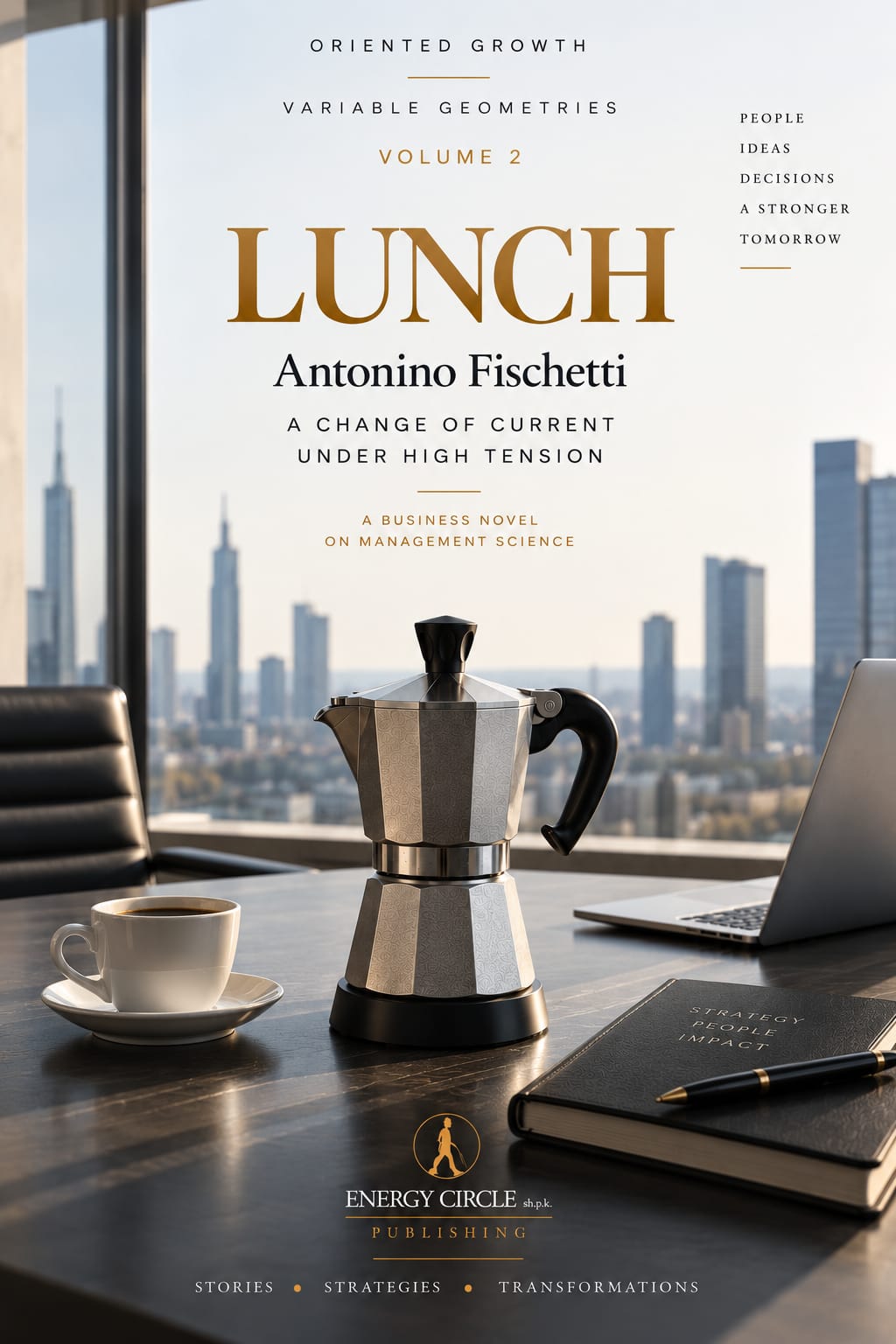
Lunch
A Change of Current Under High Tension. A business novel on management science, first edition 2026, Energy Circle sh.p.k. Publishing.
On this page
Preface
There is a time, in every growing enterprise, when listening is no longer enough and transformation is not yet complete. It is the time in between, the one nobody likes to tell, because it has neither the purity of the beginning nor the calm of the end: the time when a structure, already formed, begins to be tested by everything it cannot control.
This book tells that time. Not with the gentleness of a morning’s listening, but with the rigor of noon: the hour when the sun stands highest, the shadows shortest, and everything built in the morning must prove, under that direct light, that it truly holds.
The image guiding these pages is as simple as the one in the book before it, and just as domestic: an electric moka, no longer the traditional kind warmed slowly over a flame, but a machine that receives heat from an external source, constant and measurable, and must respond to that heat without deforming past its own threshold. It is the same principle physics calls thermal expansion: every material, subjected to a force coming from outside, expands to a point beyond which, if the force does not stop, it begins to crack. The difference between an enterprise that grows and an enterprise that breaks lies entirely in that threshold, and in the ability to know it before someone else discovers it in its place.
There is, in one of this book’s more technical pages, a cable that must choose between two ways of carrying energy from one shore of a sea to the other: alternating current or direct current, the same tension a rock band had already put, decades before any engineer, into its own name. This is no isolated case. Certain intuitions arrive first in music, or in the street, before they reach technical manuals: the writer’s task is not to invent them, but to recognize them when they come knocking again, this time in the shape of a tender specification.
Alberto Ferri and his team, in these pages, no longer face only their own choices, as in the previous book. They face what their choices meet: markets demanding speed, institutions demanding guarantees, families demanding time. Every chapter is, in this sense, a small experiment on the same question: how far can an internal structure expand before an external push alters its shape forever? It is the same question that, in other languages, a classic strategic analysis asks by dividing what an enterprise possesses from what the world opposes or offers it: a boundary line that here does not stay on the page of a method, but becomes a submarine cable, a contract, a family dinner interrupted by a phone call.
There is another shift, less visible but just as real, running through these pages without ever being openly declared until almost the end. When work can happen anywhere, remotely, with artificial intelligence already grinding through a share of the calculations that once required a desk, the office stops being the necessary place where important things happen. Work does not disappear. The question shifts to where it is still worth meeting in person. Every city this book passes through, not by chance, soon stops being a dormitory and becomes something else: a table, a square, a bridge, the place where two people look each other in the face while deciding something that matters, because that, and perhaps only that, no network can yet fully replace.
This is the middle book of a story in three movements, and like every middle time it carries within itself, without yet revealing it, the weight of what comes after. Whoever arrives here having already read the first book will recognize the same enterprise, grown; whoever meets this story for the first time will still find, chapter after chapter, the same practical question that ran through the previous book: not whether a structure must hold, but how.
There is a chapter, toward the middle of this book, where the balance between the two forces, the one pushing from within and the one pressing from without, stops for an instant in an almost perfect equilibrium, before moving again toward the story’s final part. It is no accident that it happens exactly at the midpoint. It is there, in that brief freeze-frame, that every other page of the book is best measured: not by looking at where the story arrives, but by watching the exact point where, for a moment, every force in play truly balanced out.
Beyond this book, further along the same story, the heat will change shape again. But here, under high tension, what matters is the structure’s hold under the most direct light it will ever meet.
Part One: Bucharest — Chapter 1
The Danube’s Gate
Bucharest welcomed those who knew how to read it not with the brazen charm of Western capitals, but with the industrial density of a geoeconomic hinge. From the glass front of the Romexpo exhibition center, built during the great state-fair years of the socialist era and since converted, pavilion by pavilion, into a kind of agora for the new Danube industry, the eye swept toward the great hubs of river logistics: harbor cranes standing still against the mid-morning sky, freight convoys glinting in the distance on wide-gauge tracks inherited from an age that had thought of Eastern Europe as a backwater, not a gateway.
That was where the heart of Corridor VII beat: the river axis that cut across Europe from the Black Sea to the German hinterland, carrying raw materials, energy, and steel with the deliberate slowness of the great convoys, a rhythm no market urgency had ever truly managed to speed up, because water, unlike capital, knew no shortcuts.
Vespa had arrived first, as always, and had already set up the portable moka he carried on every mission, a ritual the team had learned to trust more than any weather forecast for gauging how long the day would run: a small moka meant a quick meeting; a six-cup one spelled trouble. That morning he had pulled out the biggest one he owned, the one he only used on days when he already knew, by instinct more than by agenda, that someone would raise their voice before lunch. “Morning to you too,” said Ariane, walking in and immediately noting the size of the moka on the camp burner. “Should I be worried?”
“Just a little,” Vespa replied, pouring the first coffee without looking up from the monitors. “Last night’s data shows more drag than expected on the customs side. Nothing broken. But nothing to relax about, at least not before noon.”
“How long has it been since you started getting up before five,” asked Ariane, more out of curiosity than surprise, pouring herself a coffee in turn. “Last time I checked your message timestamps, you were already awake before dawn even in Bucharest.”
“Since I read a book that talked me into it, a few years back,” Vespa admitted, a little embarrassed, like someone confessing a habit that sounds more new-age than he’d like. “The 5 AM Club, it was called. The first hour of the day, before anyone else can claim it for themselves. At first I thought it was a passing fad. Then I found out it’s the only way I can look at the night’s data before someone’s already asking me for an answer.”
“And does it work?” asked Ariane, with a smile that didn’t quite hide her skepticism.
“It works in the sense that I’m always the first one here with the moka ready,” Vespa replied, pouring her a cup too. “The rest is for you to judge.”
Alberto Ferri set his palms down on the tactical table beside Ariane Vencourt. The mid-morning light caught the holographic displays and the structured maps the PINE Foundation had prepared for the expansion plan, projections overlaying the physical routes of Regulation (EU) 2024/1679, the core network, the extended core network, and the so-called European Transport Corridors, against the real freight flows recorded over the past eighteen months, a gap that, seen up close, said more than any institutional press release.
Ariane, with her usual geometric precision, scrolled through the financial projections for the community co-financing. “The real challenge isn’t shifting volumes, Alberto,” she began, tracing with the tip of her digital pen the intersection point between the east-west lines and the Danube axis. “The bottleneck sits in intermodality. Without an integrated hub tying together rail, waterway, and heavy road transport, every increase in output will only translate into customs congestion and financial overload. Look here.” She scrolled a waterfall chart: average transfer times by mode, broken down by node. “Every hour lost at the Giurgiu river dock turns into a contractual penalty that no industrial margin can absorb for long.”
“And the funds?” Alberto asked, though he already knew part of the answer, because he wanted to hear it said out loud, in front of the team, not just read it in a report.
“EU co-financing covers up to forty percent of infrastructure works, if the project is certified as part of the extended core network,” Ariane answered. “The rest has to be structured as project debt, with the Holding as partial guarantor. It isn’t a liquidity problem. It’s a timing problem: if the hub’s testing slips past the next European reporting cycle, we lose the eligibility window and have to reapply from scratch, with a year’s delay no client would forgive us for.”
Across the room, Vespa looked up from the telemetry terminals, while Luz and Blanca coordinated in real time the multispectral images beamed down from the observation satellites. “The positioning data confirms the diagnosis,” Vespa cut in, his calm voice slicing through the hum of the technical room. “Flows along Corridor VII show a twelve percent drag due to transfer times at the river ports. If we link this axis to Bucharest’s strategic logistics terminal, we create the first real clearing chamber between Danube traffic and the road routes heading south toward the Balkans.”
Luz zoomed in on one of the secondary monitors, a section of the satellite map where small red squares marked containers idle for more than six hours. “The problem isn’t only technical, it’s also about trust,” she said, without looking away from the screen. “Local operators prefer road unloading even when it costs more: many have worked the same route for twenty years, they know every pothole and every customs officer by name, and switching to rail doesn’t just mean trusting a new system. It means devaluing an edge built over a working lifetime. It isn’t irrationality.”
Alberto nodded slowly, in no hurry to answer. It wasn’t the first time he’d heard the objection, and he knew that dismissing it with a technical argument would only entrench it further. “Then we don’t ask them to trust the system,” he said at last. “We show them, container by container, where the data and the cargo line up. Trust isn’t declared. It’s demonstrated, one shipment at a time, until it stops feeling like an act of faith and starts feeling obvious.”
Ariane closed the folder in front of her for a moment, the way one allows oneself a pause before returning to the numbers. “You know what struck me, studying this corridor,” she said, more quietly. “That this isn’t the first time Europe has rewritten its dependencies instead of eliminating them. The Strait of Hormuz taught us what it means to depend on a single chokepoint for oil. Ukrainian gas taught the same lesson on another border, a few years back. And now, with the shift from combustion engines to electric ones, the dependency doesn’t disappear: it moves onto the critical raw materials in batteries, onto rare earths, onto whoever controls the lithium refineries. Every change of current, in the history of energy, has never closed a vulnerability. It has only moved it somewhere else, in a form that looks cleaner at first.”
Alberto looked at her for a moment before answering. “And that’s exactly why a corridor like this isn’t just a transshipment problem,” he said. “It’s a way of not depending on a single chokepoint, whatever passes through it: oil, gas, lithium, or simply data. Real sovereignty isn’t closing the border. It’s not having to trust just one.”
Ariane nodded, then added an observation that came more from her quantitative training than from geopolitics. “There’s also a subtler reason governments always wait too long to diversify,” she said. “Closing a safer but pricier supply contract today feels like a certain, immediate loss. Staying exposed to a single, cheaper supplier feels like a probable but distant risk, almost abstract. Even when the numbers say the distant risk will cost more than the immediate loss, the brain weighs the two differently. It isn’t irrationality. It’s how we’re wired to weigh certain gains against probable losses.”
“And our job,” said Alberto, “is to make that distant risk less abstract, not to wait for it to stop being one.”
His diplomatic and industrial vision sought no blind growth, only structural stability. The idea of designing an intermodal hub able to unite the great geometry of international flows with the millimetric precision of the local supply chain was the perfect manifesto of that new industrial maturity: the moment when a business stops reacting to market shocks and starts predetermining the corridors of its own transit.
The distrust Luz had mentioned did not stay abstract for long. Three days later, at the customs terminal in Giurgiu, a Romanian official named Sorin Dinescu halted an entire convoy of transiting containers, refusing to validate the documents the KINTEL system generated automatically. “A stamp on paper I can check with my own eyes,” he told Vespa, who had come from Bucharest to sort out the situation. “A number that comes off a server, I don’t know who wrote it, or whether someone wrote it to suit me.”
Vespa did not press the technical merits of the system, knowing that any argument in its favor would sound, to Dinescu’s ears, like yet another reassurance from someone with a stake in being believed. “You’re right not to trust a number that comes from whoever produced it,” he said instead. “I’m not asking you to trust us. I’m asking you to have the same data checked by a body that works for neither of us.”
Within a week, an independent inspector from the European customs authority, called in at the request of the Romanian administration itself, spent three consecutive days cross-checking KINTEL’s satellite data against physical spot checks on transiting containers. The gap between the two, at the end of the review, came in under one percent, well within the margin the customs authority itself considered acceptable for its own internal systems.
Dinescu read the report twice before signing off on the validation, with the same suspicious slowness with which he had read every document in his career. “I’m not signing because I trust your system,” he told Vespa at last, handing back the countersigned report. “I’m signing because I trust whoever verified it without owing you anything.”
That distinction, relayed by Vespa to Alberto that same evening, became the unwritten rule the team would apply to every new bout of skepticism they met along Corridor VII: never ask for trust in your own tool, always offer a third party no one had reason to suspect.
Outside the windows, a freight convoy from Constanța slowed along the shunting track, as if to confirm, with the sheer patience of its own motion, that every great infrastructure architecture always begins with a detail small enough to go unnoticed: a wheel that brakes, a container waiting its turn, a piece of data finally matching the reality it describes.
[The excerpt ends here. The chapter continues with the out-of-text notes in the volume.]
Who’s Who
- Alberto Ferri
- founder and head of the family holding. In Bucharest, Tirana, and Vienna he learns that governing a grown enterprise means answering forces he does not control, without letting them deform him past his own threshold.
- Kaltrina
- Alberto’s wife, a lawyer. She rereads every contract as if no one she knows had written it, because that is the only way to truly protect whoever did.
- Ariane Vencourt
- quantitative analyst, keeper of a Geneva circle older than any investment fund. She reads an enterprise the way she reads the steam off a moka: not by counting, but by watching where the pressure goes.
- Mapi
- coordinates structured credit lines and institutional relations. She holds the lance when it is needed, and always knows when it is someone else’s turn to take it up.
- Raffaele Roma
- site engineer. He does not trust a technical label until he sees it translated into iron, copper, or contractual variance.
- Vespa
- head of KINTEL satellite telemetry. He reads the enterprise as a physical flow of data. He rises before dawn on principle, not out of anxiety.
- Luz and Blanca
- the operational pair coordinating logistics, customs, and satellite monitoring data, in support of Vespa. Blanca carries with her the discipline of a world, the satellite one, where schedules forgive no delay.
- Francesca
- Alberto and Kaltrina’s younger daughter, at Oxford. She logs on for dinner even from a continent away, and never misses a chance to point that out, fondly.
- Sia
- the elder daughter, at Harvard. She has not yet decided where to come back to, and no one asks her to decide in a hurry.
- Vasile
- Romanian engineer, technical manager of the Serra Delta greenhouse in Galați. He learns, more slowly than he would like, to trust a system he did not build.
- Ioana
- his daughter, an agritech PhD from Wageningen. She designed the greenhouse’s predictive system before her father even learned to call it by its right name.
- Henrik Weissenberg
- manager of a Scandinavian infrastructure fund. He is not an enemy. But he has not come to Vienna to listen, and he remains the one opponent in the book who never changes his mind.
Contents
Part One: Bucharest
- 1 — The Danube’s Gate
- 2 — The Greenhouse Contract
- 3 — The Business Lunch at the Athénée Palace
- 4 — The Bucharest Signature
- Rereading, End of Part One
Part Two: Tirana and the Adriatic
- 5 — The One-Gigawatt Bridge
- 6 — The Adriatic Business Lunch
- 7 — Network Engineering
- 8 — The Dual Verification Protocol
- Rereading, End of Part Two
Part Three: Vienna
- 9 — Europe’s Notary
- 10 — The Table and Tradition
- 11 — The QBMC Model and the OKRs
- 12 — Consolidating the Global Geometry
- Rereading, End of Part Three
Appendices
- Bibliography
- Toolkit
- Author’s Note
Available on Amazon
Lunch is the second volume of Variable Geometries, the second stage of the Oriented Growth path that begins with the High Fidelity trilogy — the middle book of the three-part story opened by Breakfast.
© Antonino Fischetti, 2026. Energy Circle sh.p.k. Publishing. Excerpt published for promotional purposes.