
Family · Industry · Founder
Growing for Generations
from Heisenberg to the Space Economy
Themes: Passage · Intelligence · New Markets · Equilibrium
The margin does not come back when the volume does. The skills are in demand, but from other customers. The family does not agree on who decides.
How do you tell whether a family business is crossing a storm or has reached a fork? Growing for Generations follows Valente, a composite company of four generations, from the November letter demanding a price cut to the first written route toward the Space Economy.
Antonino Fischetti — Energy Circle Publishing
Tenth book of Oriented Growth · Amazon link coming soon.
Edizione italiana →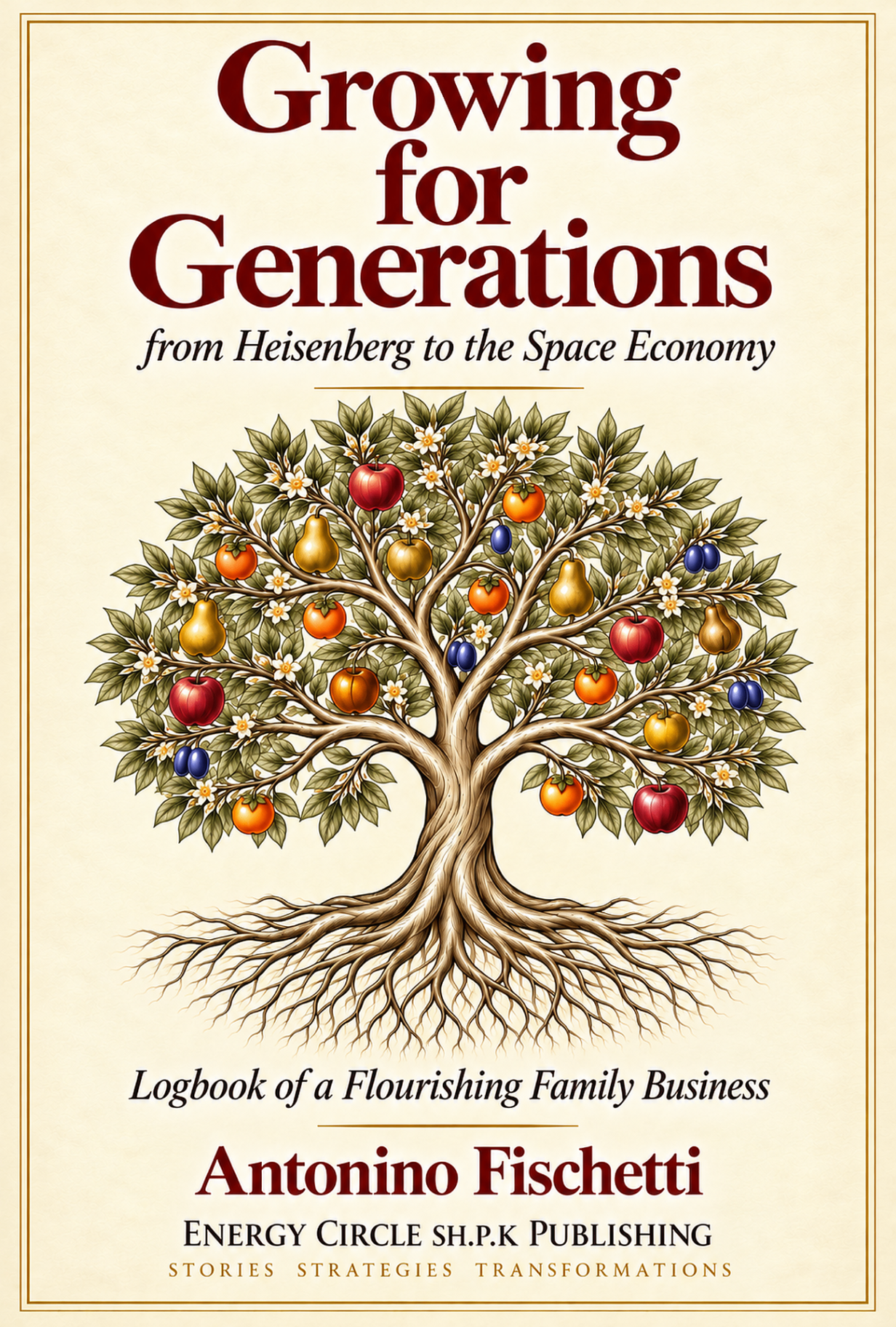
The podcast of the tenth book
Listen to the conversations accompanying the book, from the automotive supply chain to the Space Economy.
How Auto Suppliers Enter the Space Economy
Stories, Strategies, Transformations. From the uncertainty principle to the space economy: the logbook to grow a family business for generations.
From a story to a written route
Every chapter opens with a scene and closes with a tool you can fill in during one sitting: the family governance map, the propulsion map, the value progression map, the Sextant, the Helm, the 90-day review, the handover of command. By the end you will hold three sheets, one per Part: a diagnosis of the starting point, the choice of an entry door with its test and its exit, and a route that those who come after you can reread.
A method for family businesses that want to turn industrial heritage into a new trajectory, with the Space Economy as the case on which to test it. The book declares every analogy and every reading of its own, and it does not promise success: it promises dated sheets, with source and exit, readable by someone who was not in the room.
Who it is for: owners and heirs of family businesses, advisors, governance and strategy consultants, family offices, management schools.
Includes six appendices: a question bank, a glossary, an annotated bibliography, a methodological note, a logbook with tool cards, and a 90-day plan.
Tenth volume of Oriented Growth, the handbook that gathers and orients the nine novels of the series. It can be read without having read them.
The author
Antonino Fischetti, CEO of Energy Circle sh.p.k., leads the Oriented Growth framework, with which Energy Circle accompanies European family businesses through the most delicate passage in their history, the one in which value and governance pass from one generation to the next. Growing for Generations is the tenth volume of the Opera Omnia, the handbook that gathers and orients the nine novels. He lives between Tirana and Brussels.
Read the excerpt
Prologue, preface and first chapter from the English edition. The contents are included in the PDF.
Prologue
The November Before
The letter arrives in November, as it does every year, and as every year it has the tone of someone announcing a date on the calendar. A page and a half. The main customer’s purchasing office thanks them for their collaboration, recalls that the market is hard for everyone, and asks, for the new supply cycle, for a price reduction on the three component families that weigh the most.
Theresia, whom everyone at home and in the shop calls Thea, read it in the car, in the parking lot, before going in. She is the founder’s granddaughter and has run the company for twenty years: the third generation. When she sits down at the management table the math is already done, in pencil, on the back of the envelope. They can make it back: the Saturday shifts, the scrap on the second line, a phone call to whoever supplies the steel.
Bruno, the production manager, confirms it figure by figure. He knows the numbers by heart and says them in the order she wrote them down, as if he were reading them with her.
Benedikt is Thea’s son: the fourth generation. He came back a few months ago, after years spent in another industry. He sits at the far end, by the window, and says nothing. He looks at the wall where the old drawing hangs, yellowed at the corners, with the pencil notes of three generations. The oldest belongs to his mother’s grandfather, Valentin: This tolerance is not up for discussion.
When he opened the workshop, Valentin painted the sign over the gate himself, and instead of his own name he wrote Valente, so that the customers who came from the other side of the valley, and spoke the other language, could pronounce it without getting it wrong. The family still tells the story, laughing. Outside, the signs in the yard are in two languages, and no one notices anymore.
“We’ll do it like last year,” Thea says. No one objects. Bruno takes notes. Thea writes the reply, rereads it once, and signs it before lunch. The next day the customer says thank you in two courteous lines. It worked, the way it has worked for years.
From the window you can see the new building, the one Thea had built a few years ago for a line of components the market was supposed to ask for and has not asked for yet. It is her part of the drawing, the mark she wanted to leave the way Valentin left his. One of the machines is still under a tarp. The mortgage is not: that arrives every month.
On his way out, Benedikt stops at the door. “And next year?” “Next year we’ll see,” Thea answers, without looking up from her phone.
In the yard a truck is loading the week’s crates. This year’s cut will be next year’s baseline. In that room, no one says it.
Preface
How to Read This Book
Why This Book, Now
The institutional window this book moves through is open, but it is not infinite: the Action Plan for the European automotive industry, the Battery Booster, the European Union space package, the European framework on climate, energy, and digital. They all point to the same thing: Europe is redrawing its industrial base while it writes it, not afterward. Whoever leads a family business does not need to wait for the framework to be complete before starting to move: waiting is often the greatest risk.
Oriented growth does not promise to save a company from a changing world. It promises something more ambitious: that the company will flourish precisely because that world is changing, using its accumulated inheritance as fuel for a trajectory its original industry would never have allowed.
Why Automotive, but Not Only Automotive
This book enters the problem through the door of the automotive industry, and it does so for a precise reason: it is the most visible crisis, the best documented, the most capable of making concrete a phenomenon that would otherwise stay abstract. It is also, for readers who come to this book from the novels of the Oriented Growth series, familiar ground: the same supply chain is told in the nine volumes that precede it. But the diagnosis chapter 1 proposes, and the method the book builds chapter after chapter, belong to the automotive industry no more than they belong to a textile, chemical, mechanical, energy, or food company. Every family-controlled European industrial supply chain reaches, sooner or later, the same fork: an external pressure that looks cyclical but is not, mature capabilities that stay valid only if they are redirected, an institutional window that moves faster than the industry. Automotive is the example chosen for continuity and concreteness. The method is meant to be applied by anyone who leads a European family business, whatever the industry it was born in.
The Map of the Book
The volume is organized in three Parts of eight chapters each, and six closing appendices.
Part I. Diagnosing the Trajectory Crisis. Recognizing the fork and the propulsion formula; the three tensions and who holds the mandate; inheritance, the three levels, and the Propulsion Map; listening (the Walkman) and the complete diagnosis.
Part II. Heritage, Propulsion, and Capability Transfer. From the Value Progression Map and the Moka Method to the capability map, the Space Economy Entry Map, and the Entry Sheet: the passage toward a new market and the choice of a door.
Part III. Second Trajectory, Space Economy, and Generational Governance. The trajectory becomes a route, and the tools for holding it sit on the same sheet: the Sextant, traction, the Helm, the review. Then the handover of the helm, the generation that has not yet chosen, and the whole story of Valente. The geostationary orbit is the position that is held; the Space Economy is broader than the space industry alone: materials, data, services, not only satellites.
The six appendices gather the question bank, the glossary, the annotated bibliography, the methodological note, the logbook with the tool cards, and the ninety-day plan; the full “Who’s Who,” the Author’s Note, and the “To Continue” page close the volume.
A composite case, Valente, runs through the entire book, from the prologue to the last chapter: not a real person or company, but the condensation of dynamics observed in similar European family businesses.
What You Are Reading
The tools in this book were not born in a classroom. Fischetti has worked alongside family businesses for more than twenty years as an advisor and strategic counselor, on engagements that usually last three to five years, and as a rule he takes no operating role in the companies he follows. A number of business families, in different industries, are the base of experience from which the method was drawn and on which the tools were used, one after another. Today the author works on the digital and energy transition along the TEN-T corridors (the Trans-European Transport Network) of the Western Balkans.
Valente is none of these companies. It is a recomposition: traits taken from different stories, changed in industry, place, and time, were reassembled into a single company so that the reader can follow the method from beginning to end. No real person and no real company corresponds to it.
Four kinds of statement live side by side in the book, and it helps to tell them apart. When the text says a tool “usually” works, or that a step “often” jams, it speaks of what the author has observed: that is experience, not a statistic. When it says “our reading,” it proposes a model, a link the sources do not make on their own; we say so here once, and repeat it later only where it carries a thesis. Valente, its scenes, and its filled-in tables are illustration: they show how a tool is used, they do not prove that it works. The evidence is in the sources cited in the Reading Notes, each with what the book takes from it and the limit of that taking.
No tool is guaranteed. The hardest to keep, in practice, is the Sextant, because it asks every time for a second source and the second source costs something. Following a set trajectory takes time, responsibility, and courage, and that is where a written method helps most.
How to Proceed
Right after the Preface, one page introduces the people of the Valente case. Each Part opens with an image (land, sea, sky) and a short orientation text that says where you are on the journey and what you will hold in your hands at the end. The chapters stay focused on their task (a thesis, a tool, a decision) without having to repeat the general context each time, since it is set here.
Notes on the Reading • Institutional window. Action Plan for the European automotive industry (March 2025); Battery Booster (December 2025); European Union space package (June 2025). The framework on climate, energy, and digital is cited in general terms, without acts or dates.
The characters
Who’s Who in Valente
Valente is a fictional name and the case is a composite: no real person and no real company corresponds to it. This page introduces the people you will meet, without giving the story away. A fuller version, with the chapters where each one appears, closes the volume.
• Valentin. The founder, first generation. On the workshop sign he wrote “Valente” in place of his own name. • Kassian. Second generation, father of Thea and Vinz. He never enters a scene. • Theresia, called Thea. Third generation, the founder’s granddaughter. She has led the company for twenty years. • Vinzenz, called Vinz. Thea’s brother and equal shareholder. He has never worked in the company. • Benedikt. Fourth generation, Thea’s son. Back for a few months, after years in another industry. • Magdalena, called Lena. Vinz’s daughter, Benedikt’s cousin. She appears in the last Part. • Bruno. Production manager. Not a member of the family. • Alois, called Luis. Test shop technician for thirty years. • The outsiders. The main customer, its quality manager, the integrator, the laboratory, and the fund appear by role.
Chapter 1
The Thesis in One Sentence
Oriented Growth is the discipline of growing without losing direction.
In April Bruno brings a single sheet to the management office and lays it on the table face down, the way you do with cards you do not want to show right away. Thea turns it over. Three columns, one per season, and two lines for each of the three component families: how much was delivered, how much was left over. The volume is back where it was two years ago. The margin is not.
“The customer has started ordering again,” Thea says. “It’s the cycle. It comes back.”
“The volume came back,” Bruno answers, and adds nothing else. He did the math twice, at home, on Sunday.
Benedikt has a sheet of his own. He filled it in quietly over the last few weeks, going through the test shop’s mail and the requests that reached the technical office. He does not say how many there are. He says where they come from: a maker of energy storage systems, a power electronics company, a laboratory that works for aerospace. None of them is an order. All of them ask the same thing: how do you carry the heat away from a part this small.
“They’re curious,” Thea says. “They’re three industries that weren’t writing to us two years ago,” Benedikt says.
From the window you can see the new building. The line Thea wanted runs at half capacity, and the machine under the tarp is still there. Thea looks at it for a moment, then puts Bruno’s sheet back at the bottom of the folder, under the November letter, which no one has filed yet.
“And what if it isn’t the cycle?” Benedikt asks. No one answers. Bruno gathers his papers. In the yard a truck is maneuvering, and the bilingual signs tremble a little in the spring wind.
Whoever has led the same company for decades, as Thea has, recognizes the noise of a passing crisis. They have heard it before: a customer who postpones an order, a slower half-year, a market that cools down and then picks up again. But there is another noise, duller, that resembles none of the earlier ones. Margins do not come back when the cycle should turn. Capabilities stay valid for a world that is moving elsewhere. Orders are missing not for a quarter but for a structural reason no one has named yet. Whoever leads a European family business today knows this second noise well. They hear it in automotive, but not only there: they hear it every time the cost of energy adds up with the uncertainty of financial markets, every time a European policy window opens and closes faster than expected. The question they ask, almost always in silence, is the simplest and the hardest: is this a crisis that will pass, or is it the end of the road I have always traveled?
This book answers that question with a thesis that can be stated in one sentence:
From the crisis of European automotive to the Space Economy: the oriented growth of long-lived companies is the lever of strategic propulsion that turns industrial inheritance into new capability.
One sentence is explained in three steps. First step. The crisis of European automotive is not the end of a cycle: it is the signal of a change in trajectory. The capabilities built up over decades (engines, mechatronics, sensors, power electronics, advanced materials, precision manufacturing) do not disappear when an industry slows down. They relocate, if someone knows how to guide them elsewhere. In this book’s reading, the difference between a company that closes and a company that changes course often lies less in the quality of the capabilities it has and more in its ability to recognize that those capabilities belong to it, not to the industry they were born in.
Second step. Space is not a world apart from terrestrial industry. It is the segment that absorbs and values the same capabilities in a new form. Whoever works tight tolerances, nondestructive testing, materials traceability, thermal management, qualified electronics, already has, without knowing it, part of the grammar the space supply chain asks for. The leap is not only technological: it is also a leap of destination, and qualification remains a real climb, as Chapters 4 and 13 will show.
Third step. The long-lived family business can have, in facing this change, an advantage that a company driven by a short financial horizon lacks. It is not an automatic advantage: the same long horizon, if no one decides, turns into slowness. A horizon thought out in generations, not in quarters, makes it possible to bear the time a second trajectory requires: qualifications, tests, first contracts that do not generate an immediate margin. And a stock of tacit capabilities, built up by people who have lived the company from the inside for decades, is what is needed to recognize which capabilities are worth transferring, and which are not.
A Trajectory Crisis, Not a Cyclical One
The distinction between the two crises is not a theoretical question: it is the first decision an entrepreneur has to make, because the two call for opposite answers. A cyclical crisis is answered by holding out: you cut costs, you wait, you come back when the cycle turns. A trajectory crisis is answered by reorienting: you keep what has value and change the direction in which that value is applied. Confusing the two leads to the worst mistake: holding out when you should change course, or dismantling when it would be enough to hold the helm steady for one more year.
Richard Rumelt, in his work on the structure of good strategy, insists on a point that is useful here: the hardest part of strategy is not deciding what to do, but diagnosing correctly what is happening. A good diagnosis does not list every problem: it isolates which aspects of reality are truly critical and which are background noise. That is the exercise this chapter asks for.
Box: Three Indicators for Recognizing a Trajectory Crisis 1. The margin does not come back when the volume comes back. If a rise in orders does not bring profitability back to earlier levels, the problem is not demand: it is the structure of the value the market recognizes in that product. 2. The capabilities stay valid, but the customer changes. If the company’s technical know-how is still in demand (but from industries, supply chains, or geographies different from the usual ones), that is a signal of relocation, not of decline. 3. The institutional window moves faster than the market. When policy, regulation, and public programs (European, national) change course before the industry has completed its own adaptation, standing still means falling behind twice.
Three indicators do not make an exact science, but they are enough to orient the first decision: to understand whether you are going through a storm, or whether you have reached a fork.
How They Are Read in Practice The three indicators become useful only if you look at one concrete figure for each, and not at the general impression. For the first, it is enough to set side by side, for a few comparable orders, the volume delivered and the margin obtained in different seasons: if the volume has come back and the margin has not, the line shows it without any need for interpretation. For the second, you list who has asked the company for technical information in recent years, and you look at where they came from: not how many, but from which industries. For the third, you keep a simple calendar of what European and national institutions have opened or closed during the period, and you compare it with what the company did in the same period.
Two precautions. The first: one indicator alone is not enough, and two out of three already deserve a conversation in the family. The second: each one is read over a period long enough to rule out an unusual season. A bad half-year is not a fork; a run of half-years that say the same thing usually is.
At Valente, in April, two indicators out of three are already on the table, even if no one has called them that. Bruno’s sheet is the first: the volume came back, the margin did not, and the line shows it without any need for interpretation. Benedikt’s sheet is the second: the requests do not come from the usual customer, but from three industries that did not write before. No one has looked at the third yet: a calendar of what institutions have opened or closed in recent years on energy, batteries, and space, set next to what the company did in the same period. In that calendar the new building would have a date, and the line running at half capacity another. That is the work of the months ahead. For now only one thing matters: two indicators out of three, by the rule just written, already deserve a conversation in the family. Thea has not called it yet, and the November letter stays at the bottom of the folder.
The Propulsion Formula
The rest of the book is built on a simple formula, which appears here for the first time and will be developed chapter after chapter:
Strategy defines the trajectory. Propulsion makes it possible. Traction is the push that finds ground and becomes a path. Governance holds the position in orbit.
Each of these four moments corresponds to a different question (where do I want to go, do I have the push to get there, am I really moving forward, can I stay where I have arrived) and each calls for different tools, which the book will introduce step by step. For now it is enough to say that propulsion is not an isolated event: it is a process that runs through three levels, the physical (the company’s real capabilities and assets), the organizational (how the company structures itself to apply them elsewhere), and the strategic (the decision about where to direct them).
It is worth saying at once what this book does not propose. There is no outside enemy to neutralize and no border to defend. There is a form: the identity of the family business, its network of relationships, its reputation built over generations. That form is defended not by standing still, but by letting everything else change as much as needed for it to continue. You do not defend a border. You defend a continuity, by transforming what sustains it.
The subtitle borrows an image from physics. The uncertainty principle that Werner Heisenberg formulated at the dawn of quantum mechanics says that it is not possible to know with absolute precision, at the same instant, both the position and the momentum of a particle. Outside physics, and only as an analogy, something similar holds for a company in transition: it is hard to have at once, with the same certainty, the assurance of where you are and the speed at which you are moving. Whoever chases absolute certainty before moving risks standing still. Whoever accepts uncertainty as a structural condition can begin to orient their trajectory even without knowing every detail. The same holds for the most delicate passage in the story of a business family, the transfer of value and governance from one generation to the next: there too information is incomplete, and waiting for certainty before deciding can be the riskiest choice.
One Company, One Route
The chapters that follow do not speak in the abstract. They travel, season by season, through the story of Valente, the fourthgeneration automotive supplier the reader met in the prologue. In Part I Valente looks at itself: Thea, Benedikt, and Bruno fill in one tool per chapter while the next November draws closer. It is a composite case: it does not describe a real company, but it holds together dynamics that family businesses of this kind recognize, and every tool in this book will be put to the test on its trajectory, not only stated in theory.
When that story has run its course, it will not have told only how a company avoided closing. It will have told how an entrepreneurial family recognized, in its own inheritance, the fuel for a trajectory the industry it was born in would not have allowed. Not the chronicle of a survival, but that of a flourishing made possible precisely by the change that seemed to threaten it.
What This Chapter Does Not Do
The chapter does not prove the thesis: it proposes it, and the book puts it to the test chapter by chapter. It does not say that every company in difficulty should look to space, nor that the Space Economy is the answer for all: it says that the capabilities of a demanding trade can find a destination elsewhere, and that this “can” has to be checked company by company. It does not choose the route in the company’s place, not even later in the book: it is a method, not a lawmaker. It offers questions, sheets to fill in, and an order in which to use them, and leaves the decision to the people who know the company better than anyone else.
There is also a limit to the sources. Rumelt is cited for his idea of diagnosis, not because he wrote about family businesses; Heisenberg is evoked as an analogy, not as proof. They are bridges between different worlds, declared as such, and whoever prefers not to cross them can read the thesis without them.
For Whoever Comes After You
A trajectory diagnosis has one more reader than it seems. Besides whoever leads today, there is whoever comes after you and will have to understand why, at a certain point, the company changed course, or why it did not. A dated page that says what was observed, which indicators were read, and which question was asked is a modest and precious legacy: it does not ask those who follow to agree, it allows them to understand. In this book’s reading, the companies that last for several generations are not the ones that were always right, but the ones that left enough in writing to correct their own mistakes without starting over.
Practical Exercise Write the date at the top of a page and, for each of the three indicators, one figure you already have in hand, not an impression: two lines each are enough. If for two indicators out of three you cannot find a figure, that is already a piece of information.
Before Moving On
The thesis of this book can now be restated as a question, worth keeping in mind chapter after chapter: is your company going through a storm, or has it reached a fork? It is not a rhetorical question. It is the first diagnosis every reader of this book will have to make about their own company, before applying any tool in the chapters that follow.
Review Questions (for Appendix A) • Does my company’s margin come back when the volume comes back, or does it stay compressed even with unchanged demand? • Are the capabilities I have still in demand, but from customers or industries different from the usual ones? • Am I waiting for the cycle to turn, or am I already looking for where to redirect what I know how to do?
Toward Chapter 2
Recognizing the fork is the first step. The second is more delicate, because a family rarely agrees on how to cross it. Chapter 2 introduces the three strategic tensions: memory against innovation, continuity against technological discontinuity, patience against speed. Every family business has to recalibrate them, not resolve them once and for all, in order to move in a shared direction.
Notes on the Reading • Rumelt. Richard Rumelt, Good Strategy / Bad Strategy: the idea of diagnosis as the core of strategy. Cited for this idea, not as a source on family businesses. • Heisenberg. Uncertainty principle, formulated in 1927 (position and momentum): a declared analogy, not proof.
Growing for Generations gathers and orients the nine novels. If you would like to follow the journey, continue with Oriented Growth →
The chapter ends here. If you would like to talk it through with us — a business, a handover, what you have just read — write a line to office@energycircle.al, or book the 45' Listening.
Growing for Generations is the service of The Pine. It concerns the long-term continuity of entrepreneurial organisations.
How can an organisation grow without losing its own centre?
Passage
How is what matters handed on?
Intelligence
How does the organisation keep learning, understanding and deciding?
New Markets
Where can it grow without losing its centre?
Equilibrium
How can continuity, transformation, risk and growth coexist?
The trajectory of the Opera
- 019 business novels
- 023 trilogies
- 033 instruments — Walkman · Moka · Sextant
- 04Oriented Growth
- 05Geostationary orbit
The geostationary orbit
The destination is not an end point but a position of dynamic balance: the company keeps growing and transforming while remaining recognizable across generations.
Walkman
Listen
Moka
Adapt
Sextant
Navigate
Oriented Growth
Stay in orbit
From the book to the boardroom
The topics explored in Growing for Generations can become a strategic conversation for your family business.
Forthcoming
Italian and English excerpts are already available. The Amazon link is coming soon; subscribe to the newsletter for the release announcement.