
Oriented Growth › The Trajectory › Volume I
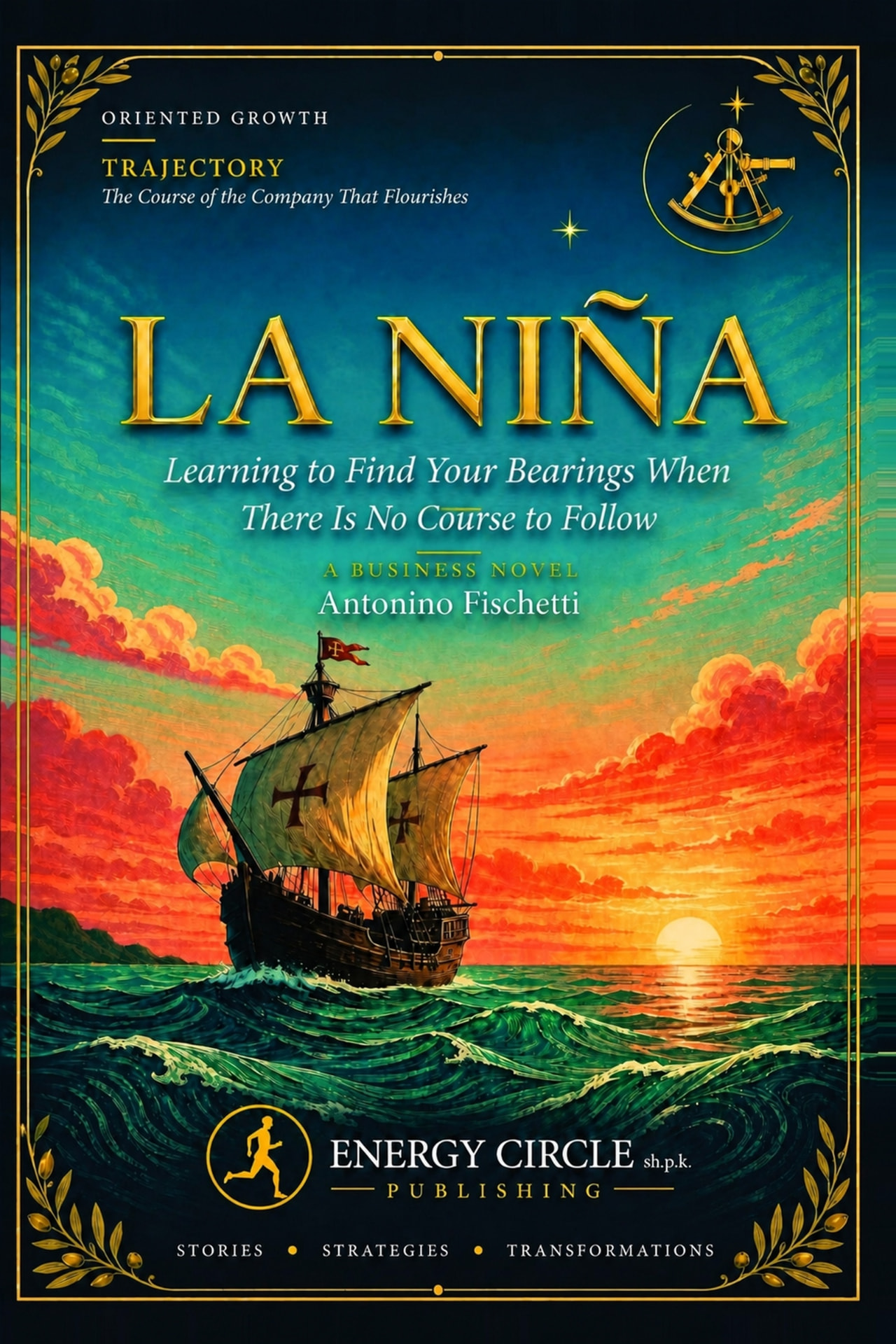
La Niña
Learning to Find Your Bearings When There Is No Course to Follow
A business novel. First English edition, September 2026, Energy Circle sh.p.k.
If you have already read the volume, two lines of review on Amazon help other readers choose — leave them here
On this page
Preface
There is a time to listen, and a time to adapt the shape of what has been heard to the reality that changes. But sooner or later there comes a third time, less comfortable than the first two: the time when the land no longer suffices, and one must learn to move across a surface that has no roads already traced, no fixed points someone else has already measured for you.
This book was born of that third time. Alberto Ferri, whom readers of this series have already seen listening and adapting, now finds himself facing a different problem: no longer understanding what is happening, no longer finding the right form to contain it, but deciding from where to measure everything else, when no one has yet told him and no one can decide in his place. A thirteenth-century cartographer, an eighteenth-century watchmaker, twenty-two delegations gathered in Washington in 1884: not one of them discovered a zero that already existed, waiting to be found. They chose it, together, and then they lived long enough for that choice to become a shared truth.
Alberto, Kaltrina, Mapi, Raffaele: the people one meets in these pages do not inherit a course already plotted. What they inherit, when things go well, is an instrument and the responsibility to learn to use it before it stops being a decoration hung around the neck and becomes something that truly orients them. It is the same instrument that gives this new series its name, and like every true instrument, it works only for those who accept taking the first reading wrong, correcting it, and taking it wrong again, slightly differently, the next time.
Antonino Fischetti
Part One: The Sextant — Chapter 1
The Weight of a New Instrument
Only a few days had passed since Edoardo had handed it to him in person, without too many words, before climbing back into his car where someone was waiting without getting out. Since then, the dark wooden case had stayed nearly always closed on the table, as if opening it all the way meant accepting something Alberto could not yet name.
Kaltrina had noticed it the first evening, without comment, and again the second evening. Only on the third had she said something: "You can simply keep it closed for another month, if you need to. The permission to open it slowly hasn't expired." Alberto had been grateful for that sentence more than he had ever openly told her.
That morning, finally, he had taken it out of the box before even his coffee, almost in secret, as if opening it in daylight made it less a symbolic gesture and more simply an object to examine. Outside, Tirana was waking to its usual ordered noise of distant horns and roll shutters rising one after another along the street, a background Alberto had stopped noticing as noise years ago.
The sextant weighed less than Alberto had imagined. He had expected it in solid brass, something that pulled the wrist down the moment you lifted it from the case; instead it lay in his palm with the lightness of an object that had never done serious work, or that had worked so long it had worn away every superfluous gram.
He turned it over twice, then a third time. The graduated arc caught the light from the window and gave it back as a thin strip on the table, a sliver of sun cut with surgical precision. He did not know where to begin using it, and this irritated him more than he would have wanted to admit. He had learned to read a balance sheet before he could read a train timetable. He had learned to calibrate a wait, to carry a weight on his shoulders without letting it weigh on others. Orienting, though, was a verb that did not yet have a body for him: he knew what it meant in the abstract, he did not yet know what it meant at seven in the morning, with a cold coffee and three calls already missed.
"You're holding it like a microphone," Kaltrina said from the doorway.
He did not look up from the sextant. "I'm holding it like an instrument I've never used."
"It's the same thing, in the end." She came in and sat down across from him, with the calm Alberto had learned to recognize as the antechamber of a question that mattered. "Can I ask you something as a lawyer, not as your wife?"
"I'd rather you didn't, but you'll ask it all the same."
"What changes, in a family pact, if instead of 'consolidate' we write 'orient'?" She said it in the same voice with which, years before, she had asked him to explain the difference between an option and a preemptive right: not out of curiosity, but for work.
Alberto set down the sextant. "To consolidate means to hold still something that already exists. To orient means to choose where to send it, even if that means moving it away from where it is doing well today."
"And who decides where the 'where' is?"
He did not answer right away. It was exactly the question the sextant, silently, had been asking him for a quarter of an hour.
The phone buzzed on the table before he could try to answer. A message from Mapi, brief, in her usual style that never wasted time on preambles: Corridor not starting Monday, Romanian permits slipping three weeks. No drama, just a change of course. Camino Infrastructure had its own way of reminding Alberto that orienting was not a philosophical exercise to be done at the kitchen table: it was something that happened every day, on a site miles away, while he was still learning the names of the instruments.
He replied with a single word: Reason? Mapi sent a photo: a stamp on a form, the correct date handwritten in pen above an incorrect printed one, and below it an illegible signature. An official wrote the wrong year on the original permit. Three weeks to have him correct it, because in the meantime he has gone on vacation and no one else will touch his file. Alberto laughed alone in the kitchen, for the first time all morning. So the Corridor is delayed by a bureaucrat's vacation. The reply came, dry as always: Welcome to the Balkans. At least this time it isn't our fault.
He read the message twice. There was no real urgency, only the usual friction between the project's time and bureaucracy's time that no one ever managed to align completely. And yet one thing struck him that Mapi had not written but that he felt anyway, behind the brevity of the message: she was not short of resources. She was short of a precise direction in which to spend them. She had teams ready, capital allocated, skills that at Camino Infrastructure were running ahead of what the single site required at that exact moment. It was not a problem of scarcity. It was a problem of aim.
He raised the sextant again, almost by chance, and looked at it with different eyes than a minute before. Perhaps it was not the instrument's job to help him understand where to go. Perhaps its first task was to show him how much, in that moment, he already had everything he needed to set out, and no line traced on which to run.
"Kaltrina," he said, without looking at her. "I think the problem was never what we lack."
Kaltrina did not answer right away. She let him get to the rest of the sentence on his own, as she always did when she knew he was about to say something he would need to hear again later, perhaps written down, perhaps in a contract.
"The problem is that we have more than we know where to put," he finished.
She nodded, without comment, and that silence was the first real confirmation that he had said something exact.
At noon, as on every day for years, Raffaele sent the KINTEL briefing: five lines, never one more, the same format he had used since the company had only two people. Corridor: permits delayed, no action required. Durrës site: consumption within normal range. Cable supplier: quarterly check scheduled. PINE: no updates. Note: no exceptions to report today.
Alberto read it twice, as he always did, not because it contained anything new, but because that daily rhythm, five lines identical in form even when the content changed, was itself a kind of silent governance: not a written principle, a habit that kept everyone aligned without anyone having to convene anyone else.
"Did you get the briefing too?" he asked Kaltrina, who was arranging some files on the table next to her.
"Always. Even when it says only 'no exceptions.'" She did not look up from the files. "The day it stops arriving is the day we'll need to worry, not the day it says something bad."
In the early afternoon they went out to walk, as they did when both of them needed to think without having to say it out loud. The Blloku was full of its usual orderly confusion: outdoor cafés despite the air still cool, bicycles parked crooked, a flower vendor who had known Kaltrina by name for years and who every time offered her the same discount that she every time refused on principle.
"You never buy anything from him," Alberto said.
"If I bought, he would stop offering me the discount. It's a balance we both enjoy."
They walked as far as Rruga e Dibrës, where the Kadare mural occupied the entire facade of a building, directly across from what had once been his home: the face, the thick glasses, a pile of books painted beneath the portrait like a foundation. Alberto passed it almost every day, in one direction or the other, and almost never stopped to really look at it.
"Have you read any of them?" he asked, stopping this time.
"The Palace of Dreams, at university. An imaginary ministry that collects and interprets every citizen's dreams, in order to anticipate who will become dangerous to the State." Kaltrina stayed looking at the mural longer than necessary. "I found myself thinking back to it last night, while I was reading the first reports KINTEL will send on a regular basis."
"We don't interpret anyone's dreams."
"No. But we collect data on people who trust us without ever having read a line of what we collect. The difference between his imaginary palace and our real framework is not the technology. It is only who decides, in the end, what to do with what has been collected, and why." She turned toward Alberto, almost smiling. "A novel about a ministry of dreams never leaves you indifferent, when your job is writing the rules for another kind of ministry, a much smaller one."
"And The Incident?" Alberto asked, remembering the title on a shelf at home. "Have you read that one?"
"That one is about two people killed in a car accident in Vienna, and an investigator who spends the whole book trying to reconstruct what really happened between them in the car, without ever quite getting there." She took up walking again, leaving the mural behind. "Sometimes I think that with the framework, we are doing the same thing: trying to reconstruct afterward, with order, something that in reality happened in a single instant, with no order at all."
They went back inside for lunch, and Alberto's phone rang just as they were setting the table: Francesca, from Oxford, her voice arriving a little breathless, as if she had run up the stairs to answer in time. "Dad, I only have five minutes between classes. I just wanted to know: the sextant, have you used it for anything real yet?"
"Not yet. I'm still trying from the balcony."
"From a balcony it will never work, you know that, right?"
"I've been told that already, yes." Alberto smiled, laying the phone on the table so he could keep setting it while he talked. "How are your classes going?"
"Good. There's a professor who keeps repeating that every important decision in a company should be explainable to a ten-year-old in under a minute. I keep thinking of you every time he says it."
"And do I manage it, in your opinion?"
"I don't know yet. You'll tell me, in a year, when you've finished what you're writing with Kaltrina." He heard her attention drift for an instant, the sound of other voices passing in the corridor. "I have to go, class is about to start. I love you. Try that sextant somewhere a real horizon actually exists, sooner or later."
That evening, after dinner, Alberto took the sextant up to the terrace. The Tirana sky was not yet fully dark, a low orange strip above the buildings toward the west, light enough to make any serious attempt at measuring something ridiculous.
He tried all the same. He brought the instrument to his eye as he had seen it done in a video he had watched twice that afternoon, and tried to slide the small movable mirror along the graduated arc until the image of the low sun overlapped the image of the horizon, visible through the transparent half of the eyepiece. The two images refused to align. The sun trembled, slipped away, came back a finger higher every time he believed he had held it still.
"It doesn't work like that on a balcony," Kaltrina said, having come out without his noticing.
"I can see that."
"You need a real horizon. A clean line, the sea, not the rooftops of a neighborhood." She leaned on the railing beside him. "I read it while you were in the shower. It's the principle of double reflection: the light bounces twice off the mirrors, and the angle that comes out is twice the angle between the mirrors themselves. That's why the scale is calibrated to sixty degrees but reads up to a hundred and twenty."
"So the instrument is right. It's me who doesn't have the right horizon."
"It's you who doesn't have the sea, for now." Kaltrina took the instrument from his hands and turned it over with the same care she would have used to handle an original document instead of a photocopy. "A man invented it almost three hundred years ago. An Englishman and an American, at almost the same moment, without knowing of each other. Before that, they used the astrolabe."
"And it took them all that time?"
"Newton had already understood the principle decades earlier. He never published it." She handed the sextant back. "Sometimes the principle exists before anyone builds the instrument that makes it useful. And sometimes the instrument exists before anyone has the right horizon to use it."
"There's one thing that struck me, while I was reading," Kaltrina added. "Fifty years after Harrison, a ship called the Beagle sailed around the world to fix the exact points of longitude wherever it passed. It didn't carry one chronometer. It carried twenty-two, all together, in the same cabin."
"Why so many?"
"Because no instrument, on its own, deserved total trust. The captain compared them against one another every day, and trusted the average, not the single best." Kaltrina pointed at the sextant, still in Alberto's hands. "At the end of the voyage, five years, tens of thousands of miles, the total error was thirty-three seconds. The captain still found it too much, almost inexplicable."
Alberto lowered the instrument and let it rest against his chest, the strap still around his neck. "So for now it's just a weight I carry for no reason."
"For now it's a weight you carry before knowing the reason. It isn't the same thing." Kaltrina looked past the rooftops, toward the west, where the orange strip was finally about to go out altogether. "When you have a real horizon in front of you, you'll already know how to hold it. You won't have to improvise everything at once."
"How do you know all these things?"
"I didn't know them until last night. I read about them while you were in the shower, because I realized you would read only the technical part, never the human part." She pulled her jacket tighter, the evening cool beginning to make itself felt. "An instrument without its history is just metal. With the history, it becomes something you can carry around without feeling ridiculous, even before you know how to use it."
They stayed a moment longer on the terrace, the darkness advancing slowly. "Can I ask you this one too as a lawyer, not as your wife?" she said.
"Go ahead."
"Today, if someone asked you who really decides at Camino Holding, what would you answer?"
Alberto thought about it longer than he expected. "Me."
"Only you?"
"I listen to Mapi on infrastructure, Raffaele on the data, you on everything else. But if I had to point to a single person on an organization chart, it would be me." Saying it out loud, he heard how much more fragile it sounded than it had ever seemed to him in private. "Is that a problem?"
"It's a fact, for now. It becomes a problem on the day when you can no longer be the one to answer that question, and no one else knows what to answer in your place." Kaltrina pulled her jacket tighter against the evening cool. "I'm not telling you to share power tomorrow morning. I'm telling you that the document we are about to write will have to answer this question too, sooner or later, not only the one about the zero."
By the time they went back inside, it was fully dark, the sun dropped below anything the sextant could have measured from a city balcony. Alberto put the instrument away in its case without having taken a single real measurement, but with fingers that already remembered, at least a little, where to find the alidade in the dark.
The phone signaled a message as he closed the case: Sia, from Boston, at an hour that over there would still have been afternoon. Dad, Mom told me about the sextant. Does it work? Below, without waiting for an answer, a second line: Actually no, I don't want to know now. Tell me about it the next time we talk with some calm, not in a message between classes.
Alberto smiled and replied with equal brevity: Not yet. But I'm learning what it lacks. He added nothing more. He knew it would be enough, for now, and that the rest of the story, as always with Sia, would find its own moment later on, when they both truly had the time to listen to it.
[The excerpt ends here. The story continues in the book.]
Who's Who
- Alberto Ferri
- : founder and guiding hand of Camino Holding. He has learned to listen and to adapt; here he learns to orient, discovering that a principle written down well is worth more than a hundred exceptions foreseen in advance.
- Kaltrina
- : Alberto's wife, a lawyer. She reads a contract with the same care with which, for years, she has read her husband: without his having to say a word, and without ever stopping to ask him the uncomfortable question.
- Edoardo Brandani
- : a shipowner, member of the Hundred Plus. He gave Alberto the sextant. He guides without ever putting himself in the place of the one steering, even when it costs him his silence on things he has wanted to say for years.
- Raffaele
- : co-founder of KINTEL, responsible for the background noise being zeroed out before every real decision. He never decides in Alberto's place: his job is to leave him with only the question that counts.
- Mapi (María Pilar Ibarra)
- : leads Camino Infrastructure. She decides with the instinct of someone who knows every face of her own site, often more quickly than a framework would require, almost always in exactly the right way.
- Francesca
- : the younger daughter of Alberto and Kaltrina, at Oxford. She observes more than she speaks, and when she writes, it is to change what she receives, not merely to comment on it.
- Sia
- : the elder daughter of Alberto and Kaltrina, at Harvard. She finds in case studies the same energy others find elsewhere, and she does not stop at a principle until she has truly put it to the test.
- Ariane
- : part of the Hundred Plus, commands her own rowboat when she needs to think without saying it out loud. She teaches Alberto to trust the distance.
- Genti
- : a young technician on Mapi's site. He is not family, but in the field he earns the same kind of trust.
Contents
Openings
- Preface
- Who's Who
Part One: The Sextant
- Chapter 1 — The Weight of a New Instrument
- Chapter 2 — The Archive of Genoa
- Chapter 3 — The Tables of Amalfi
- Chapter 4 — The Ship That Has Not Yet Sailed
- Re-Reading: The Sextant
Part Two: Meridian Zero
- Chapter 5 — The Meridian
- Chapter 6 — The Formalization
- Chapter 7 — Trusting the Distance
- Chapter 8 — The Misalignment
- Re-Reading: Meridian Zero
Part Three: Alla Via Così
- Chapter 9 — The Return
- Chapter 10 — The Stress Test
- Chapter 11 — The Calculated Course
- Chapter 12 — The Ship That Does Not Repent
- Re-Reading: Alla Via Così
Appendices
- The Oriented Growth Architecture: A Closer Look
- Chapter-by-Chapter Narrative Bibliography
- Author's Note
- Colophon
The first course
La Niña opens The Trajectory: three ships, three ways to hold a course when the horizon changes.
If the chapter said something to you, the most useful review is the one that tells it: two lines on Amazon, leave it here — it helps other readers choose.
The chapter ends here. If you would like to talk it through with us — a business, a handover, what you have just read — write a line to office@energycircle.al, or book the 45' Listening.
© Antonino Fischetti, 2026. Energy Circle sh.p.k. Excerpt published for promotional purposes.