
The Walkman Method
First volume of the Alta Fedeltà trilogy. Preface and chapter 1.
If you have already read the volume, two lines of review on Amazon help other readers choose — leave them here
The Walkman Method is the starting point. If you want to continue the path, Oriented Growth gathers nine novels across three series, three instruments, and a route for listening, adapting, and orienting the family business. Continue from Oriented Growth →
A Note on This Edition
This book was written in Italian and is set in a workshop outside Madrid. It is published in English from Brussels, and that is not an administrative detail. The method it describes was built for the European companies that make things: eighty people, one rented shed, two customers, and a trade that is narrowing.
The book carries one argument. A European company that defends its position where everyone is already competing spends itself, because on that water the price is set somewhere else. A European company that takes what it knows how to do and carries it where nobody is competing yet has the whole of its skill working for it again. Not protection, and not cost. Movement.
Brussels, 2026
On this page
Preface
In the life of every company, as in the life of every person, there comes a moment when the things that brought it into being are no longer enough.
It does not happen because of a mistake. It happens because the world around it has moved, and what was once a strength has become simply the way things have always been done. Whoever leads the company notices late, and almost always looks outside for the reason: a competitor, a regulation, a customer who is leaving. Looking outside is human. It is also useless. None of those reasons tells you what to do on Monday morning.
It is the most fragile moment and at the same time the most fertile. It is also the moment when a generation is handed something it never asked for, and nobody can yet tell it whether this is an inheritance or a debt.
This book tells one year of that moment.
A woman with eighty people to pay and a decision to make by March. A consultant who enters, listens, and does not promise to know how the story will end. Five gestures anyone could perform who ever carried a cassette player in a pocket: rewind, forward, play, pause, stop.
There is nothing to study here. There are a little over a hundred pages, which is an afternoon or two evenings: enough for something to move, too little for it to become a course.
And beneath all the others there is one idea. A company that has lasted fifty years has roots that still hold, intact, down there. What has to change is not the roots: it is the fruit, because no tree bears the same fruit for fifty years, and nobody asks it to.
In the end the new generation receives a gift.
Chapter 1
Paris, 1995
Mapi arrived in Paris with a suitcase too small for three weeks and a coat her mother considered too light for November.
She was twenty and in no hurry to know what she would become.
Her mother, by contrast, always seemed to have an answer ready for important things: the right coat for a French November, the exact time needed for a tortilla to remain soft inside, the moment when a conversation should be interrupted and the moment when it should be allowed to continue by itself.
In Getafe, in the workshop her parents had rented in 1964, that competence had a name nobody ever said. Her father had the hands. Her mother had the ear. Anyone looking for work spoke to him. Anyone looking for money spoke to her. It was not a division written anywhere, and precisely for that reason it had lasted thirty years.
One evening, when she was fifteen, Mapi had asked her mother how she could tell before everyone else which orders were going to go wrong. «Listen,» her mother replied. One word. As if it were enough.
Paris, on the other hand, seemed to listen to nobody. The city moved. Taxis crossed boulevards shining with rain and pulled away before the light had finished being green. People walked as if every one of them, without exception, had an important appointment.
On a Friday evening Béatrice took her to a party. A large stereo occupied almost an entire piece of furniture: amplifier, compact-disc player, a row of knobs that in the half-light looked like instruments on a control panel. Two speakers on either side of the room made the floor vibrate.
Mapi noticed something curious. To speak, you had to bring your mouth close to the other person's ear, and then nobody was really speaking. The music was loud. It was beautiful. And it belonged to everyone. And precisely for that reason, she thought, it did not really belong to anyone.
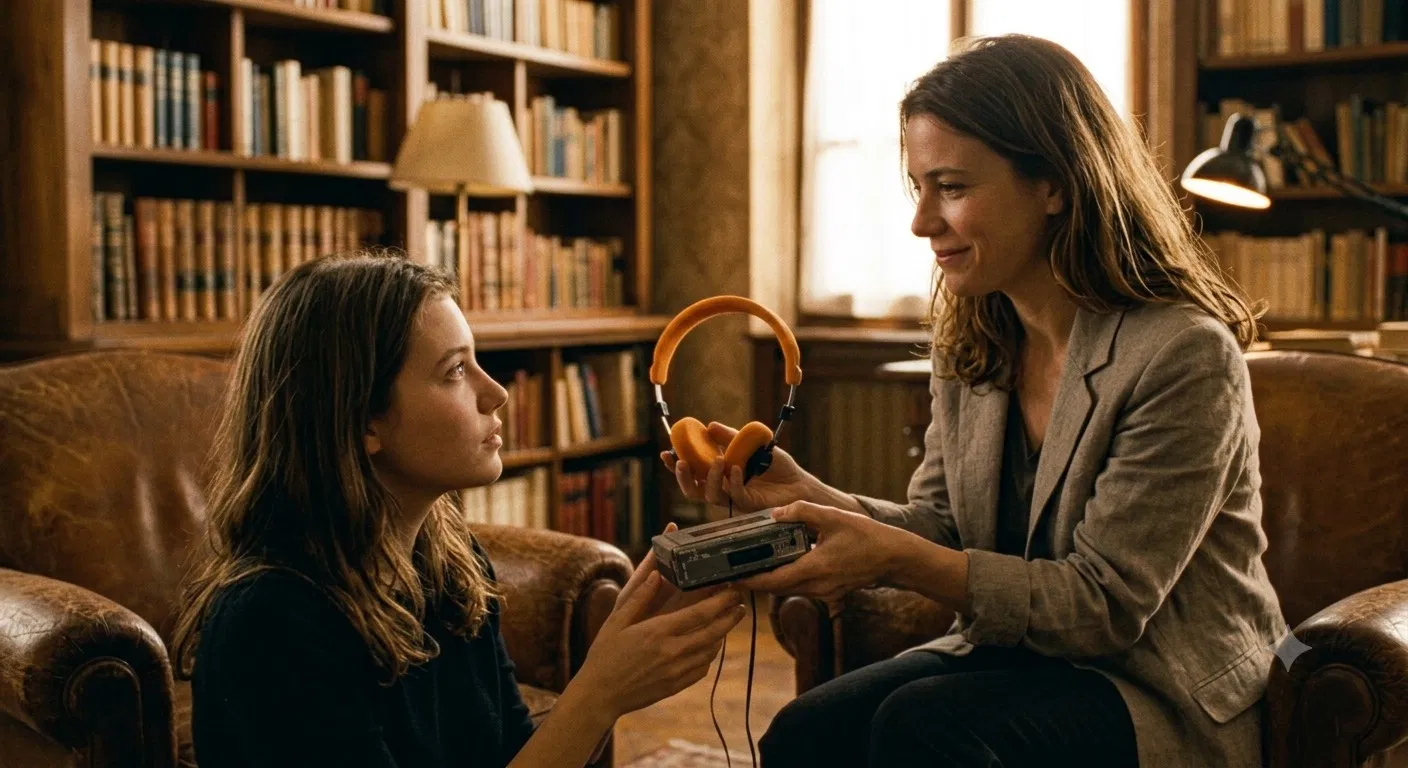
That was when she saw a girl sitting on the floor, her back against a shelf, knees drawn up, eyes closed. Around her, the party continued exactly as before. She was somewhere else. She had two small headphones over her ears, joined by a thin band, and a cable running down to the device resting on her legs.
The girl opened her eyes and smiled. She removed one headphone. «Want to try?»
Mapi put them on. And something happened. The party did not disappear. It was still all there. The chaos continued, identical, and yet it no longer belonged to her. Because now, inside that chaos, there was a space of her own.
The music was very close. It no longer came from the room. She could hear the singer's breath, the breath taken before a line, the tiny sound of fingers changing position on a string — details that no powerful stereo had ever made her hear, because a powerful stereo fills a room, and a room is already full of everything else.
She felt something she could not have put into words at twenty, and would only be able to put into words much later: she was not choosing the music. She was choosing where to be.
«Do you like it?» Mapi nodded. «Why?» She looked again at the room: the raised arms, the smoke, the glasses on the floor. «Because the party goes on.»
Many years later, Mapi would recognise the uncomfortable part of the story in that feeling. Headphones take nothing away from anyone. They give you back the measure of what you were living inside without noticing.
[The excerpt stops here. The chapter continues in the book.]
Contents
Part one. The party and the headphones · Paris
- 1. Paris, 1995
- 2. Getafe, Thirty-One Years Later
- 3. From Hi-Fi to the Walkman
- 4. Passing It On
Part two. The controls · Madrid
- 5. Rewind
- 6. Forward
- 7. Play, Pause, Stop
- 8. The Minutes
- 9. High Fidelity
Part three. The blossoming · Rome
- 10. Sixty Shafts in Fourteen Months
- 11. The Occupied Chair
- 12. Via dei Condotti
Closing
- Epilogue
- Mapi's tape
- Appendix. The first conversation
- Author's note
If the chapter said something to you, the most useful review is the one that tells it: two lines on Amazon, leave it here — it helps other readers choose.
The chapter ends here. If you would like to talk it through with us — a business, a handover, what you have just read — write a line to office@energycircle.al, or book the 45' Listening.
© Antonino Fischetti. All rights reserved. Excerpt published for promotional purposes.